

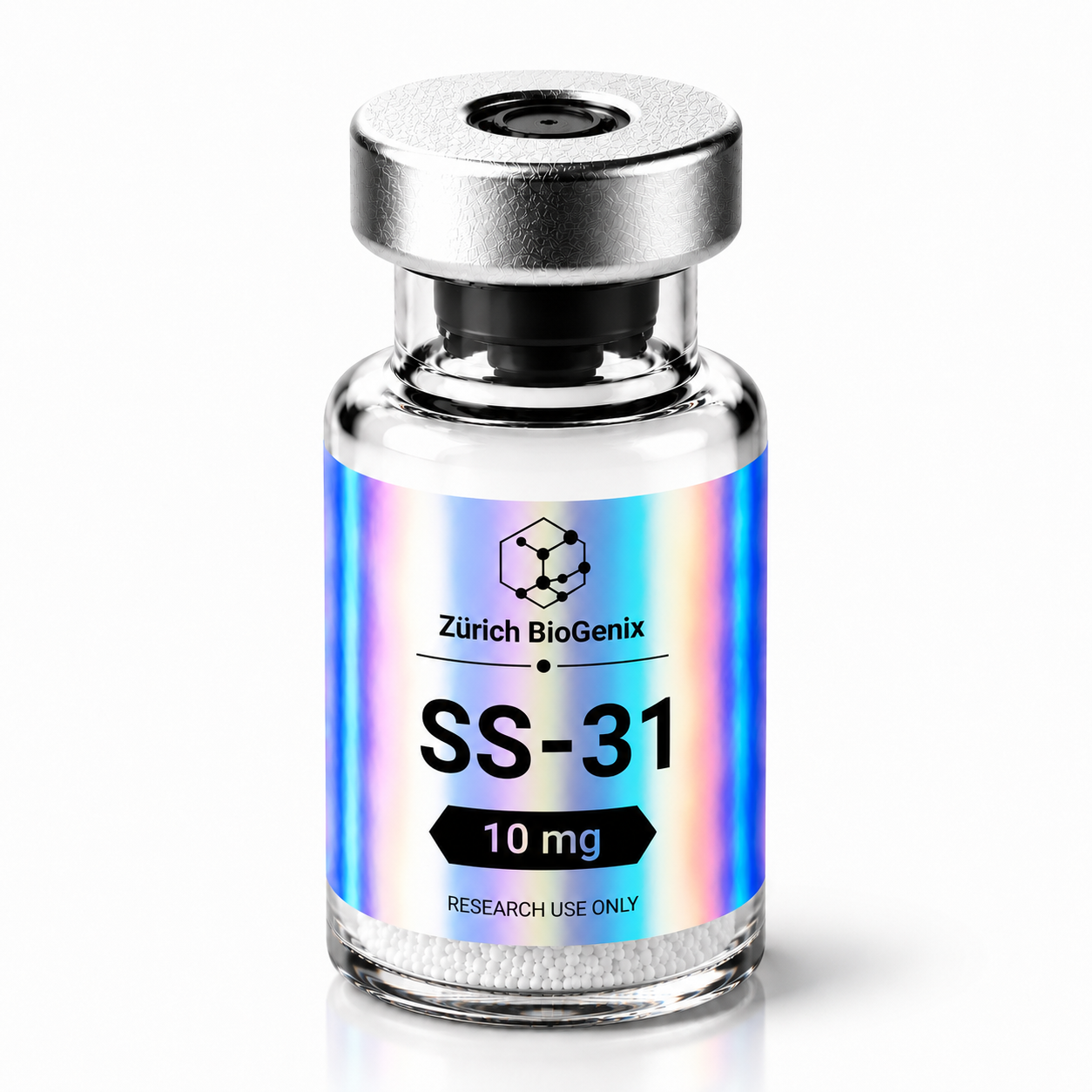
Research summary
SS-31 has been studied in cell and animal models of mitochondrial dysfunction and ischaemia-reperfusion injury, and has also been evaluated in clinical trials for mitochondrial and cardiac conditions. This summary describes what the literature has investigated. It is not a claim about the effects of our product, which is supplied for laboratory research only.
Mechanism of action
SS-31 (also known as elamipretide) is a short synthetic tetrapeptide containing alternating aromatic and cationic residues. In published work it accumulates in the inner mitochondrial membrane, where it is reported to associate with cardiolipin and to influence electron transport chain organisation and reactive oxygen species production.
Chemical properties
Sequence: D-Arg-Dmt-Lys-Phe-NH2 (4 residues, Dmt = 2',6'-dimethyltyrosine, C-terminal amide). Molecular weight: approx. 640 g/mol. Form: lyophilised powder. Purity and identity: see the batch Certificate of Analysis (HPLC and mass spectrometry).
Storage and handling
Supplied as a lyophilised (freeze-dried) powder. Store sealed, cold, dry and protected from light, as stated on the Certificate of Analysis and product label. Allow the vial to reach room temperature before opening to limit condensation. Avoid repeated temperature cycling and humidity exposure. For laboratory research use only.
Literature references
Selected PubMed records on elamipretide (SS-31), scientific background only, not claims about our product. PMID 31747905: SS-31 and lipopolysaccharide-induced mitochondrial dysfunction, synaptic and memory impairment in a preclinical model. PMID 34480713: elamipretide treatment and age-associated post-translational modifications of heart proteins. Open any record at https://pubmed.ncbi.nlm.nih.gov/PMID/ . More: https://pubmed.ncbi.nlm.nih.gov/?term=elamipretide+OR+SS-31
For laboratory research use only. Not for human or veterinary use. Nothing on this page is medical advice.


